Paris
The Best Werewolf Short Stories 1800-1849Paris is the decisive offstage center in the crisis surrounding Michael Thilouze and Francoise Thilouze. Although the principal danger unfolds in the mountain village of Loques and at Cabanis, Paris gathers the knowledge, social power, and political authority capable of changing events there. Michael travels toward it in pursuit of the philosopher’s stone; Victor de Vardes is sent there to remove him from the reach of the Montmorencis; and Pierre Bloui’s desperate journey to the city ultimately brings back a royal order that interrupts the execution.
A Promised Center of Knowledge
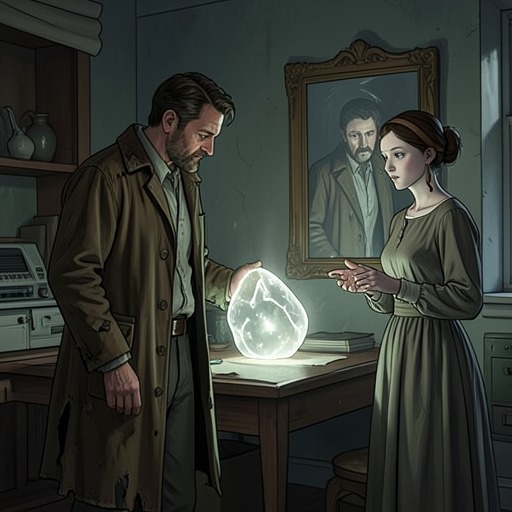
Paris first appears as the destination of Michael Thilouze’s intellectual and financial gamble. Nearly seventy years old, the physician has spent years in nightly vigils over crucibles, exhausting both his health and his means in experiments intended to discover the elixir vitæ and the philosopher’s stone. At the moment when his resources are failing and his hopes are expiring, he receives a letter from Paris announcing that an Italian who has recently arrived there has discovered the grand secret. The city is therefore presented not merely as a place on a map but as a fountain of authoritative knowledge, a metropolitan source from which the isolated experimenter hopes to obtain what his own lonely work has failed to yield.
Michael responds by abandoning further attempts to grope in the dark and setting out for Paris to visit the successful philosopher. Before leaving, he sends Francoise to stay with her cousin Manon Thierry in Loques. That decision creates the physical separation on which the later danger depends: Michael goes toward the city’s promise of enlightenment, while Francoise enters the village society in which rumor, jealousy, and superstition will soon place her life at risk. Paris thus stands in contrast with the secluded dwelling where Michael has educated Francoise in mystical lore, natural observation, herbs, flowers, and the stars. Its attraction is the authority of a newly announced discovery; its narrative consequence is that father and daughter are apart when accusation begins.
Distance and the Removal of Victor de Vardes
Paris also becomes a site of imposed separation. Victor de Vardes is there shortly before the events at Cabanis because his father has sent him away on a pretext, the real purpose being to remove him from the neighborhood. The city consequently embodies the power of family strategy and aristocratic control: Victor’s absence is not accidental, and it leaves Francoise without the protection of her lover when Michael and his daughter are seized on a charge of witchcraft.
The distance between Loques and Paris magnifies the danger. Manon Thierry knows that Victor is the only person who might secure assistance, yet she cannot write to him or send a letter even if she could compose one. In a world without rapid posts, Paris is close enough to contain the necessary remedy but far enough away to make rescue uncertain. The city’s significance lies in this cruel double condition. It is the place where help exists, and the distance that makes help almost impossible to obtain in time.
Pierre Bloui’s Embassy
When the trial condemns Michael and Francoise to die at the stake, Manon summons Pierre Bloui and asks him to go to Paris to inform Victor of the impending disaster. Pierre fears the Montmorencis and hesitates to undertake so rash an enterprise, but Manon argues that he can replace one employer with another because Victor will assuredly become his best friend. When persuasion alone does not suffice, she offers the most costly inducement available to her: if Pierre will hasten to Paris without stopping night or day and report the danger, she will marry him on his return.
Pierre’s decision is strengthened by conscience as well as by the promised marriage. He has privately changed his opinion of the accused after seeing the lame wolf beneath the chestnut trees; he could have shot it but feared that his lord and lady would be displeased. The sight contradicts the charge that Francoise is the wolf, since Francoise is imprisoned while the animal remains outside. Pierre nevertheless has been told by Jacques Renard not to meddle in what does not concern him. His journey to Paris therefore crosses a boundary imposed by servility. Love and conscience triumph over fear, and at sunset he begins the road to the city.
Paris and the Royal Intervention
Pierre faithfully performs his embassy. He reaches Victor de Vardes, whose ardent prayers and representations move Henry IV to act. The king hastily furnishes a mandate commanding a respite until the case can be investigated further. Paris is not described through its streets or buildings; its dramatic presence is carried by the chain of communication running through it: Manon’s plea, Pierre’s dangerous ride, Victor’s appeal, and the king’s order.
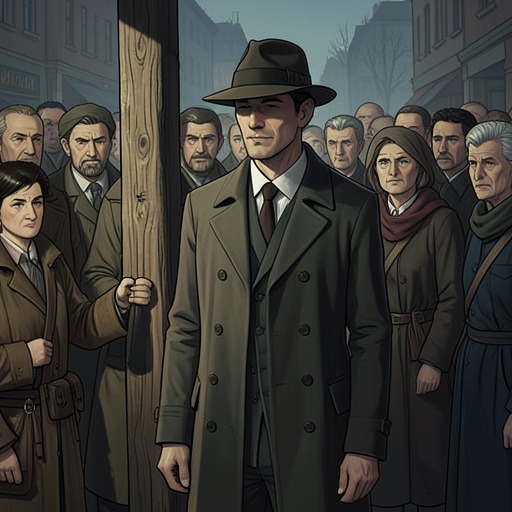
The result is delivered back at the execution scene by Victor, who arrives on a foam-covered horse carrying the king’s order for arrest of execution. His approach transforms the atmosphere of the crowd, and the royal command changes the legal and social balance at once. Once it is known that Henry favors the lovers, the supposed harmlessness of Michael and Francoise is generally acknowledged. The wolf lacking a foot, formerly treated as proof of their guilt when joined to Francoise’s missing left hand, is now accepted as proof of their innocence. Paris has therefore supplied more than a place of refuge: it has supplied the political authority that can reverse an irrational judgment.
Narrative Significance
Paris operates as a remote counterweight to the village’s enclosed world of rumor and spectacle. In Loques, the preparations for the witch-burning become a public entertainment, while the evidence against Michael and Francoise is shaped by powerful enemies and superstition. Paris, by contrast, concentrates learning, lovers’ appeals, royal power, and the possibility of further investigation. The contrast does not make the city an uncomplicated realm of justice: Michael’s journey begins in pursuit of alchemical certainty, and Victor’s presence there is the result of a father’s manipulative removal. Yet Paris remains the only place from which the threatened lives can be defended effectively.
Its function is consequently structural as much as geographical. The city creates delay, because Victor is absent and Manon cannot communicate directly; it enables movement, because Pierre undertakes the perilous embassy; and it produces reversal, because the embassy reaches the king. The rescue finally confirms the young couple’s marriage under royal countenance and protection, while exposing the instability of the village trial’s reasoning. Paris is the book’s distant mechanism of correction: knowledge draws Michael toward it, separation sends Victor there, and authority returns from it in time to prevent the stake from becoming the final measure of truth.